Solution treatment and aging: design guide for precipitation hardening
Learn how solution treatment and aging works, which alloys use it, how to call out tempers on drawings, and how to avoid distortion and over-aging.
Solution treatment and aging, also called precipitation hardening, strengthens specific alloys in three steps: dissolving alloying elements at high heat, quenching to trap them in solution, and aging at a lower temperature so fine particles precipitate and block dislocation slip. Because the final aging step uses moderate temperatures, you can machine or form parts while the metal is soft and then harden them to full strength with very little distortion. This guide covers the alloys that use the process, how to specify tempers, and how to design parts that survive the quench and keep their strength.
What it is and how it works
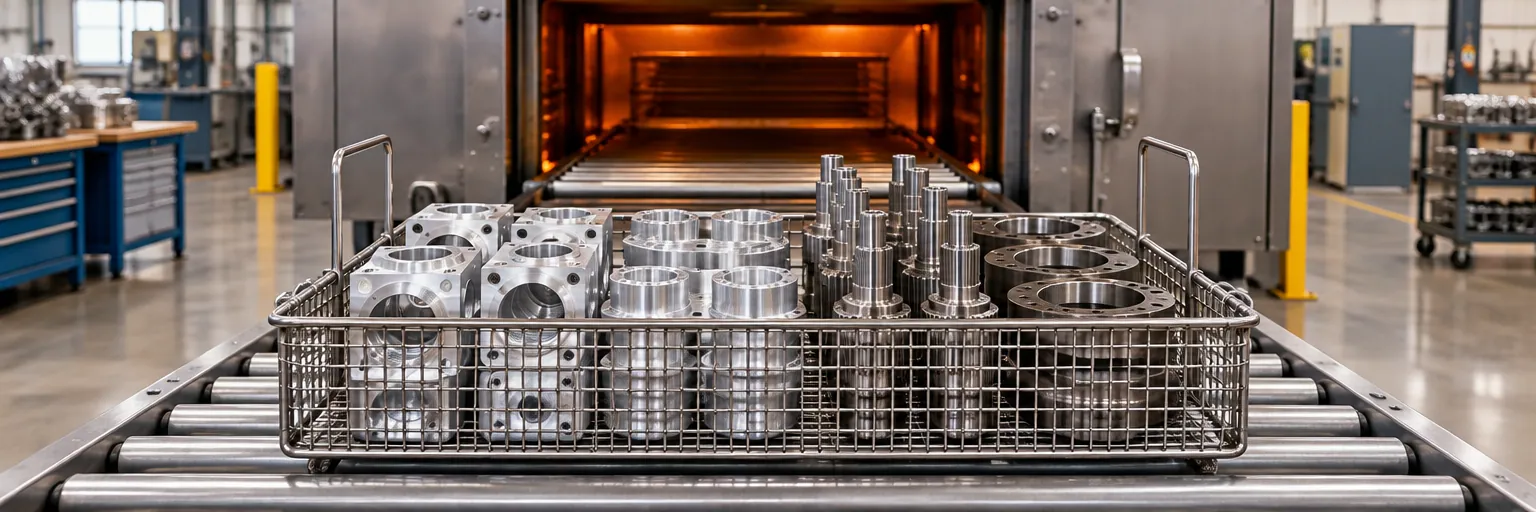
Precipitation hardening runs in a heat treatment furnace and strengthens metal in three stages:
- Solution treatment: The alloy is heated into a tight temperature band until its alloying elements dissolve into the base metal.
- Quenching: The part is cooled rapidly to room temperature (or lower) to trap those dissolved elements in a supersaturated solid solution. At this stage, the metal is still relatively soft and workable.
- Aging: The quenched alloy is held at a moderate furnace temperature (artificial aging) or at room temperature (natural aging) so the dissolved elements precipitate out as fine particles. These particles block slip and dislocations, raising the strength and hardness of the part.
This process applies to heat-treatable wrought aluminum alloys (2xxx, 6xxx, and 7xxx series), precipitation-hardening (PH) stainless steels like 17-4 PH, beryllium copper, titanium alloys, and nickel superalloys. It differs from quenching and tempering, which is the hardening route for carbon, alloy, tool, and martensitic stainless steels. For precipitation-hardening alloys, the solution treatment on its own acts as the annealing step.
When to use it
Use solution treatment and aging when you need high strength in a precipitation-hardening alloy, especially when the part requires difficult forming or close-tolerance machining first.
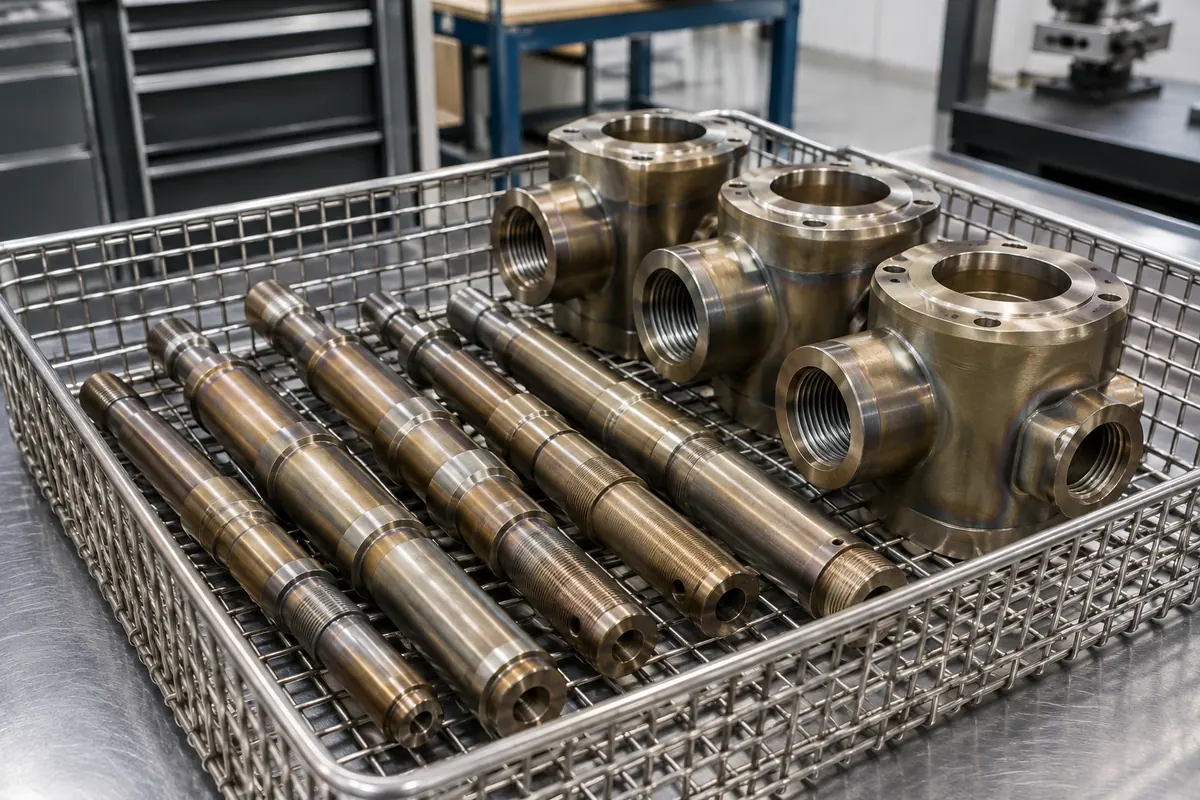
- Machined stainless steel parts: 17-4 PH stainless steel is rated excellent for this process. You can buy it in the solution-treated condition (Condition A) or an overaged condition (such as H1150), machine it while soft, and then age it. Because aging is a low-temperature step with only a small, predictable contraction, finished parts need little or no final grinding.
- Formed springs and contacts: Beryllium copper is rated excellent. Shops form intricate shapes from soft strip or wire, then age the finished parts to full spring strength.
- Formed aluminum sheet and extrusions: When a bend in 2024, 6061, or 7075 aluminum is too tight for a hardened temper, shops either form annealed stock and run the full solution and aging cycle, or form the part in the freshly quenched W temper before aging.
- High-temperature service: Nickel superalloys (rated excellent) and titanium alloys rely on precipitation hardening for their high-temperature strength.
Aluminum tempers and cycles
On aluminum drawings, specify the standard Aluminum Association temper designation rather than writing out a custom furnace cycle. The letters and digits after the alloy number define both the thermal sequence and the required mechanical properties:
- O: Annealed, the softest wrought temper.
- F: As fabricated, with no property limits.
- H tempers: Used for non-heat-treatable alloys that are strain-hardened (H1 is strain-hardened only, H2 is strain-hardened and partly annealed, H3 is strain-hardened and stabilized; the second digit gives hardness from 2 for quarter-hard, 4 for half-hard, 6 for three-quarters-hard, to 8 for full-hard; H112 is as fabricated with property limits).
- W: Freshly solution heat-treated and quenched; an unstable, soft state that ages at room temperature.
- T3: Solution heat-treated, cold-worked, and naturally aged.
- T4: Solution heat-treated and naturally aged to a stable condition (T42 indicates the user solution-treated the part, used for 2014 and 2024).
- T6: Solution heat-treated and artificially aged in a furnace (T62 indicates user solution treatment and aging for 2014 and 2024).
- T73: Solution heat-treated and artificially overaged in a two-step cycle.
- T8: Solution heat-treated, cold-worked, and artificially aged.
- Stress-relieved tempers: Adding 51 (such as T351, T451, T651, T851, and the extruded/drawn variants ending in 510 or 511) means the stock was stress-relieved by stretching to a 1 to 3 percent permanent set after quenching. T652 means stress-relieved by compression and then artificially aged.
Different aluminum families respond differently to aging. Alloy 2024 reaches T3 and T4 strength by natural aging at room temperature over several days without an aging furnace; furnace aging 2024 produces T6 or T8 tempers, which change its strength and corrosion behavior. By contrast, wrought 6061 is typically solution treated at 530 °C (985 °F), quenched, and artificially aged at 160 °C (320 °F) for 18 hours to reach T6.
Where thick sections, forgings, or parts under sustained tension in 7075 face stress corrosion cracking (especially in the short-transverse direction), specify 7075-T73 instead of T6. The two-step overaging treatment trades some T6 strength for much better resistance to stress corrosion cracking and exfoliation.
PH stainless steel conditions
For precipitation-hardening stainless steels like 17-4 PH, specify the standard condition on the drawing. Never put solution-treated Condition A material directly into service, as its untempered structure lacks toughness and stress corrosion resistance.
Under ASTM A564/A564M, 17-4 PH bar is solution treated to Condition A at 1900 °F ± 25 °F (1040 °C) and cooled in air or oil to below about 90 °F (32 °C) so the martensite transformation completes. From Condition A, a single low-temperature air-cooled aging step sets the final balance of strength and toughness:
- Condition H900: Aged at 900 °F ± 15 °F (482 °C) for 1 hour. This gives the highest strength and hardness, but the lowest toughness and the highest susceptibility to stress corrosion cracking.
- Condition H1025: Aged at 1025 °F ± 15 °F (552 °C) for 4 hours. A middle ground that trades some peak hardness for better toughness and ductility.
- Condition H1150: Aged at 1150 °F ± 15 °F (621 °C) for 4 hours. An overaged condition that provides high toughness, good stress corrosion resistance, and soft enough material to machine directly in the aged state if needed.
Designing parts to control distortion
The two thermal steps behave very differently regarding part geometry: the high-temperature solution quench distorts parts and locks in stress, while the low-temperature aging step causes almost no warpage.
When a part is quenched in cold water from solution temperature, its surface cools and contracts before its core. Thin walls and asymmetric cross-sections warp, and thick sections trap high residual stresses that will move your dimensions later if you machine metal away.
Follow these rules to manage distortion:
- Avoid solution-treating finished machined aluminum parts: Instead, machine parts from pre-aged, stress-relieved plate or bar (such as T651 or T652) so the quench and stress relief are already done at the mill.
- Leave stock if you must solution treat: If an aluminum part must be solution treated and quenched after rough machining, keep wall sections as uniform as possible and leave machining stock for a final cleanup pass after aging.
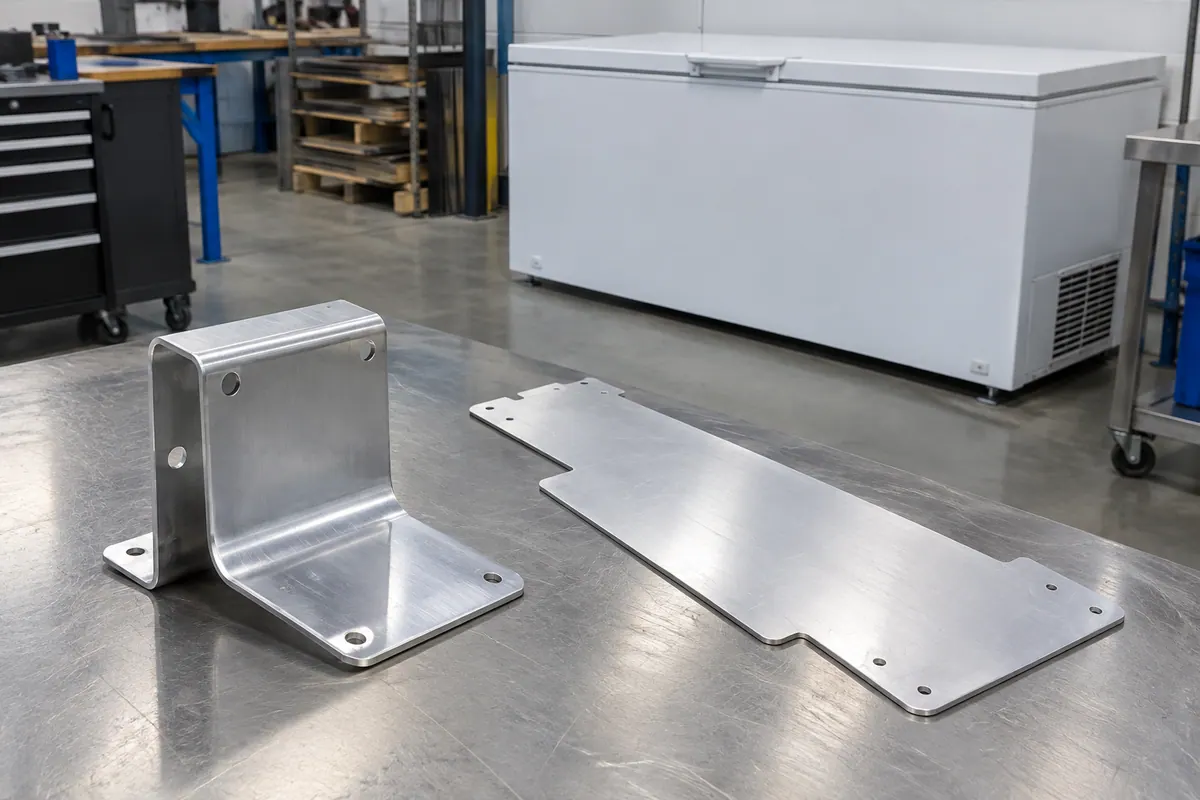
- Straighten immediately after quenching: If a sheet metal or extruded part warps during the solution quench, have the shop straighten it immediately in the freshly quenched condition while the metal is still soft. Straightening after aging introduces new residual stresses and risks cracking.
- Form severe bends in the W temper: Aluminum is most ductile right after the quench. Because natural aging starts within hours at room temperature, shops form severe bends immediately after quenching or store the quenched blanks in a refrigerator to delay aging until the press is ready.
- Heat-treat before riveting: Always finish solution treating and aging aluminum details before riveting an assembly together, which prevents warping the assembly and avoids trapping corrosive quench residues between mating sheets.
What to watch out for: heat, quench delays, and testing
Precipitation hardening is sensitive to time and temperature at every stage, including post-processing steps after the part leaves the heat treater.
- Eutectic melting from overheating: During solution treatment of 2xxx, 6xxx, and 7xxx aluminum (especially 2024 and 7075), the furnace temperature sits very close to the alloy's solidus. Exceeding the allowed temperature band melts the grain boundaries. This eutectic melting cannot be fixed by re-heat treating; the parts must be scrapped. Heating below the band leaves the alloy under-dissolved and weak.
- Slow quenches: Parts must move from the furnace into the quench within seconds, with the shortest allowed delays on thin sections. Cold water is preferred for aluminum, though bulky forgings sometimes use hot or boiling water or an air blast to limit quench stress. If transfer or cooling is too slow, coarse precipitates form during cooling, reducing both strength and corrosion resistance in alloys like 2024 and 7075.
- Over-aging from secondary operations: Heating an aged part above its aging temperature coarsens the precipitates and permanently softens the metal unless the entire solution and aging cycle is repeated. Welding, brazing, hot forming, or high-temperature powder-coat ovens will soften the heat-affected zone. Never reheat 2017 or 2024 aluminum above 212 °F (100 °C), even to bake primer or paint, without planning a complete re-heat treatment afterward.
- Re-treating clad aluminum: Limit how many times Alclad 2024 or 7075 sheet is solution treated. At solution temperatures, copper and zinc from the core rapidly diffuse into the pure aluminum cladding, destroying its corrosion protection. Thin clad sheet tolerates the fewest cycles.
- Stock identification and hardness testing: Mill aluminum carries ink markings in rows about 5 in apart on sheet and plate, and every 3 to 5 ft on bars, tubes, and extrusions. If stock is unmarked, a drop of 10 percent caustic soda (sodium hydroxide) turns high-copper alloys (2014, 2017, 2024) black, while Alclad blackens only on the exposed core edge; however, alloys like 6061 and 7075 will not blacken and require chemical or spectrographic analysis. Finally, use hardness testing on aluminum only to sort annealed, cold-worked, and aged tempers of a known alloy, never as standalone proof of tensile strength or proper heat treatment.
Standards to call out on drawings
Call out the governing material and heat-treatment specification plus the target temper or condition on your drawing, and ask your heat treater to verify the exact cycle for your part's section thickness.
- AMS 2759: Governs the heat treatment of steel parts, including precipitation-hardening stainless steels through its specific slash sheets.
- ASTM A564/A564M: Covers hot-rolled and cold-finished age-hardening stainless steel bars and shapes, defining standard conditions such as Condition A, H900, H1025, and H1150.
- SAE AMS2770: Governs the heat treatment of wrought aluminum alloy parts, setting furnace uniformity, solution temperature bands, maximum quench delay seconds by thickness, aging cycles, and re-solution limits for clad sheet.
Design rules at a glance
| Rule | Value | Note | Source |
|---|---|---|---|
| 17-4 PH solution treatment (Condition A) | 1900 °F ± 25 °F (1040 °C), cool below 90 °F (32 °C) | Cool in air or oil; do not put Condition A material into service un-aged. | [2] |
| 17-4 PH aging to Condition H900 | 900 °F ± 15 °F (482 °C) for 1 h, air cool | Highest strength and hardness; lowest toughness and stress corrosion resistance. | [2] |
| 17-4 PH aging to Condition H1025 | 1025 °F ± 15 °F (552 °C) for 4 h, air cool | Trades some peak strength for improved toughness and ductility. | [2] |
| 17-4 PH aging to Condition H1150 | 1150 °F ± 15 °F (621 °C) for 4 h, air cool | Overaged condition for high toughness, stress corrosion resistance, or machinability. | [2] |
| 6061 aluminum solution treatment temperature | 530 °C (985 °F) | For wrought 6061 prior to water quenching to W temper; soak time depends on thickness. | [3] |
| 6061-T6 artificial aging cycle | 160 °C (320 °F) for 18 h | Standard artificial aging cycle for solution-treated and quenched 6061 sheet and plate. | [3] |
| Maximum reheat temperature for 2017 and 2024 aluminum | 212 °F (100 °C) | Do not exceed during paint or primer baking without full re-heat treatment afterward. | [5] |
| Stress-relieved aluminum stretch permanent set (-Txx51) | 1% to 3% | Applies to tempers such as T351, T451, T651, and T851 to minimize machining distortion. | [5] |
| Caustic soda solution for sorting high-copper aluminum | 10% sodium hydroxide | Turns 2014, 2017, and 2024 black; does not identify 6061 or 7075. | [5] |
| Mill marking spacing on aluminum stock | 5 in rows (sheet/plate); 3 to 5 ft (bar/tube/extrusion) | Check stock markings before cutting to preserve alloy and temper traceability. | [5] |
Common questions
- Should I machine 17-4 PH stainless steel before or after aging?
- Machine it before aging, in the solution-treated condition (Condition A), or buy it in an overaged condition such as H1150 if you want to machine it already aged. Aging from Condition A happens at 900 °F to 1150 °F (482 °C to 621 °C) and produces very little distortion and only a small, predictable contraction, so finished parts rarely need post-aging grinding.
- Why did my machined 6061 aluminum part warp during heat treatment, and how do I prevent it?
- Solution treatment requires a rapid water quench from 530 °C (985 °F), which cools the surface faster than the core and distorts thin or uneven sections. To avoid this, do not solution-treat finished machined parts; instead, machine the part directly from pre-heat-treated, stress-relieved stock such as 6061-T651 plate or bar. If you must heat-treat after rough machining, leave stock for finish machining after aging.
- Can we powder coat or bake primer on heat-treated aluminum parts?
- Be careful with oven temperatures. Heating an aged alloy above its aging temperature over-ages the precipitates and softens the metal. For 2017 and 2024 aluminum, never reheat parts above 212 °F (100 °C) to bake primer or paint unless you plan to completely re-heat-treat the parts afterward.
- When should I specify 7075-T73 instead of 7075-T6?
- Specify 7075-T73 for thick sections, forgings, and parts subjected to sustained tensile stress in corrosive environments, particularly in the short-transverse grain direction. The two-step T73 overaging cycle gives up some of T6's peak strength in exchange for much better resistance to stress corrosion cracking and exfoliation.
- How do shops form tight bends in 2024, 6061, or 7075 aluminum without cracking the metal?
- Aged tempers like T6 have lower ductility and will crack on tight bends. Shops either form the part in the annealed (O) temper and then solution treat, quench, and age it, or they solution treat and quench the blank first and form it immediately in the soft, freshly quenched W temper (using refrigerated storage to pause natural aging if forming must wait).