Sawing design guide: stock prep, contour radius and finish
Learn when to use sawing, how to account for machining stock and minimum band saw radii, and what tolerances and finishes to expect from a shop.
Sawing is the standard shop process for cutting raw bar, tube, plate and extrusion to length or roughing out blanks before final machining. Because it requires no programming and removes only a narrow kerf, it is the lowest-cost cutting method available. This guide covers how sawing works, how to design parts that start as sawn blanks or vertical band saw contours, and what defects to watch out for.
What sawing is
Sawing cuts stock to length or shape using a toothed blade on a power saw with a reciprocating, band or circular blade. Like milling or turning, it is a chip-forming process where each tooth removes a small chip. However, sawing removes only a narrow kerf and leaves the remaining material intact.
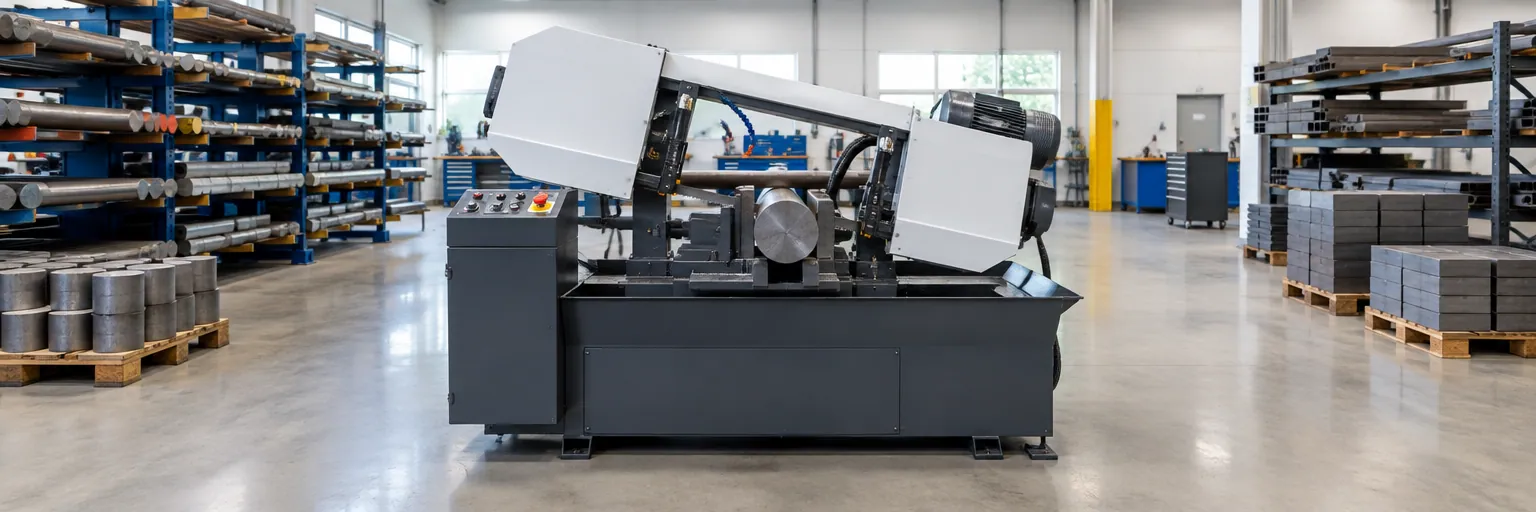
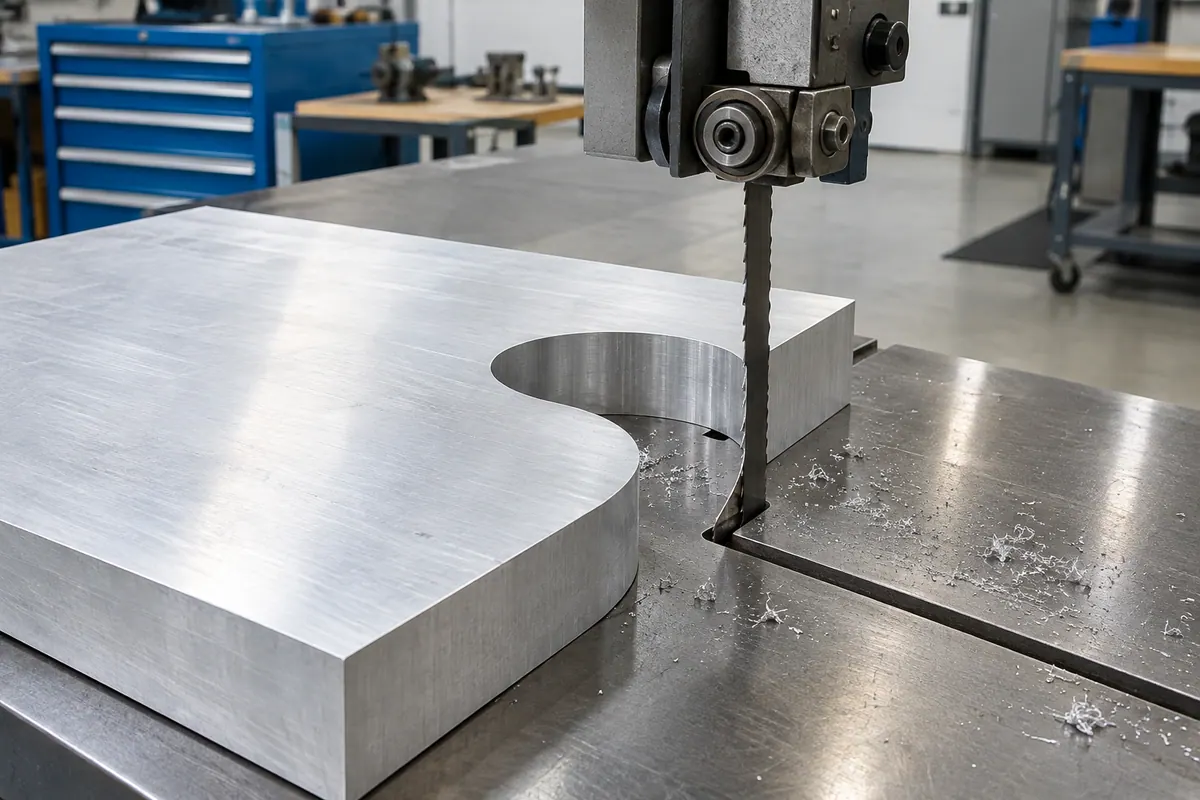
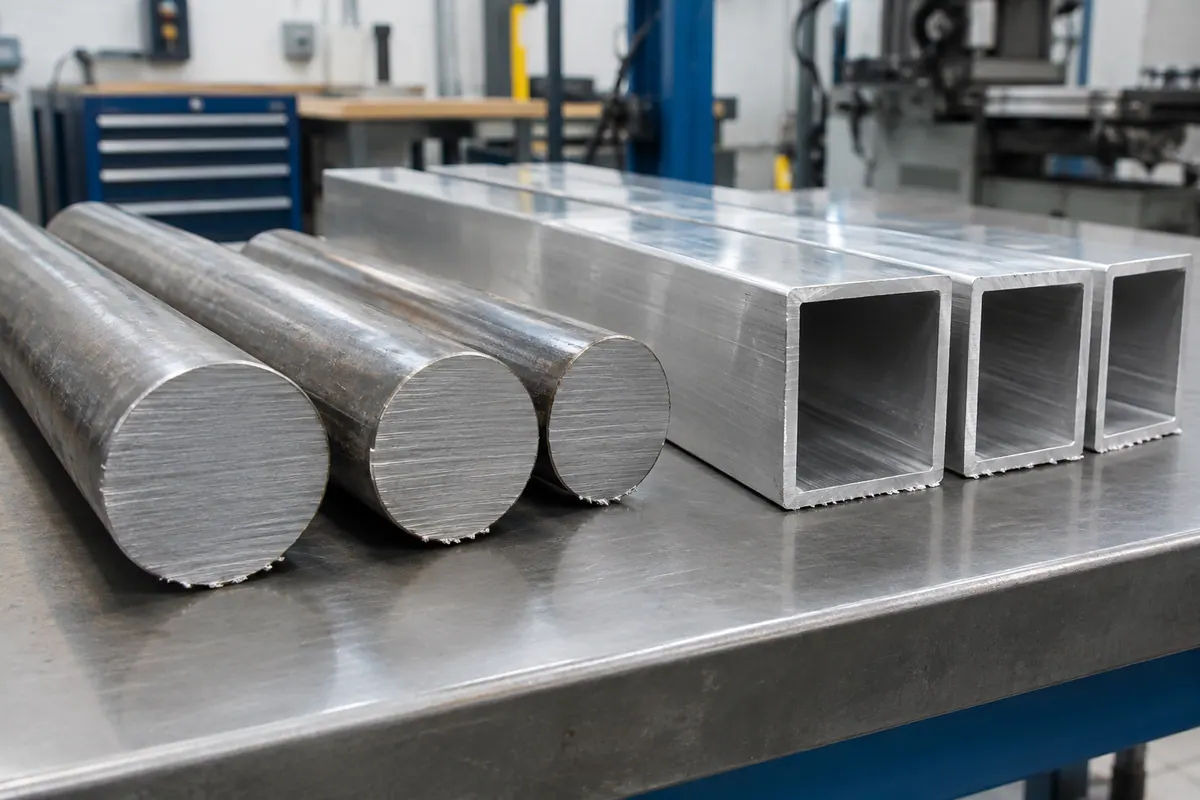
In a fabrication or machine shop, sawing is primarily a preparation step. Horizontal band saws, power hacksaws and circular saws cut bars, tubes, plates and extrusions to length before machining or welding. Vertical band saws also cut two-dimensional contours directly into plate.
When to use it
Use sawing whenever raw stock must be cut to length or a blank roughed out. It needs no programming and is the cheapest cut available.
Sawing suits larger workpieces and softer metals where tight tolerances and smooth finishes are not required on the cut face. Common materials include mild steel, aluminum, brass, stainless steel, tungsten and engineered wood (which saws easily, using fine blades on sheet goods to avoid chipping the surface veneer).
Choose a different process when precision or sheet speed matters:
- For accurate profiles in sheet, use a laser or waterjet.
- For fast straight cuts in sheet, use a shear.
- For precise end lengths and squareness on bars or tubes, saw the blank oversize and machine the sawn end to final size.
Designing for sawing
No universal standards govern sawing tolerances, kerf width or squareness. Treat any sawn face as a rough face that will be machined later. Do not dimension critical features from a sawn edge, and always add extra stock length for facing on a mill or lathe. If a part will remain as-sawn, ask your shop what length tolerance and squareness their saws hold.
If you are designing a plate part to be contour-cut on a vertical band saw, your internal curves determine the widest blade the shop can use. Shops prefer to use the widest, thickest band possible for rigidity and straighter cuts, but wide blades cannot turn sharp corners. Reference values from U.S. Army machine tool guidelines relate blade width to the minimum internal curve radius:
- 1 in (25.40 mm) wide blade: 7.25 in (184.1 mm) minimum internal radius
- 1/2 in (12.70 mm) wide blade: 2.5 in (63.5 mm) minimum internal radius
- 1/4 in (6.35 mm) wide blade: 0.625 in (15.9 mm) minimum internal radius
- 1/8 in (3.17 mm) wide blade: 0.125 in (3.2 mm) minimum internal radius
- 1/16 in blade: capable of cutting a square corner
Design internal contours with the largest radius your assembly allows so the shop can run a wider, stiffer blade.
Tolerances and surface finish
In ordinary production, the surface roughness of an as-sawn face ranges from 1.6 to 25 um Ra (63 to 1000 uin Ra). The rough end of this range comes from coarse band and power hacksaw cuts, while the smooth end comes from fine circular sawing.
On a band saw, the finest finish is achieved by pairing a fine tooth pitch with high blade velocity, a light feed rate and cutting fluid (used on most metals except cast iron, and never used on portable band saws where liquid can damage guide bearings or rubber pulleys). Vertical band saws can also be fitted with file bands or aluminum-oxide and silicon-carbide polishing bands (in 50, 80, 120 or 150 grain) to deburr, file or finish sawn edges.
Tooling and material thickness rules
While the shop selects the blade, understanding blade pitch rules helps you anticipate issues with thin-wall parts. At least three saw teeth must remain in contact with the workpiece at all times. If fewer than three teeth engage the cross-section, the blade snags, chatters and strips its teeth.
- Thick and soft stock requires coarse teeth and a raker set pattern so the gullets have enough space to clear large chips. For example, stationary power hacksaw blades range from 4 to 14 teeth per inch (TPI), using 4 TPI for solid aluminum and 10 TPI for solid brass.
- Hard materials require finer teeth and lower blade speeds to spread cutting pressure across more teeth and reduce wear. On a two-range vertical contour saw (which runs 50 to 375 feet per minute in low range and 260 to 1,500 feet per minute in high range), speeds under 275 feet per minute use the low transmission range.
- Thin sections such as sheet metal, thin-wall tubing, angles and channels require a wave set pattern and fine pitch (such as 14 TPI on a power hacksaw, up to 24 TPI on a portable band saw, or 18 to 32 TPI on a portable hacksaw).
If a sheet metal part is so thin that even the finest blade cannot keep three teeth in the cut, the shop must sandwich the sheet between plywood, fiberboard or thicker metal to support it.
What to watch out for
Keep these common sawing limitations in mind when specifying sawn stock or blanks:
- Heavy burrs: Sawing leaves heavy burrs, particularly in softer metals, tubing and sheet. Plan for a deburring step or secondary machining.
- Blade wander: As a blade dulls or if feed pressure is too high, the blade is forced to one side. Long cuts are neither perfectly straight nor perfectly square.
- Chatter and tearing: Thin-wall tubes and sheet metal vibrate, chatter and tear unless clamped securely close to the cut and cut with a fine-pitch blade.
- Heat marks on hardened steel: Sawn ends of hardened steel experience localized heating and heat-marking. Always allow extra stock so this heat-affected layer can be machined away.
Design rules at a glance
| Rule | Value | Note | Source |
|---|---|---|---|
| As-sawn surface roughness (Ra) | 1.6 to 25 um (63 to 1000 uin) | Average production range from fine circular saws to coarse band and hacksaws | [3] |
| Minimum teeth in contact with work | 3 teeth | Required at all times to prevent snagging, chatter and broken teeth on thin sections | [2] |
| Minimum internal radius (1 in wide band) | 7.25 in (184.1 mm) | Vertical band saw contour cut with a 1 in (25.40 mm) blade | [2] |
| Minimum internal radius (3/4 in wide band) | 5.4375 in (138.1 mm) | Vertical band saw contour cut with a 3/4 in (19.05 mm) blade | [2] |
| Minimum internal radius (5/8 in wide band) | 3.75 in (95.3 mm) | Vertical band saw contour cut with a 5/8 in (15.88 mm) blade | [2] |
| Minimum internal radius (1/2 in wide band) | 2.5 in (63.5 mm) | Vertical band saw contour cut with a 1/2 in (12.70 mm) blade | [2] |
| Minimum internal radius (3/8 in wide band) | 1.4375 in (36.5 mm) | Vertical band saw contour cut with a 3/8 in (9.52 mm) blade | [2] |
| Minimum internal radius (1/4 in wide band) | 0.625 in (15.9 mm) | Vertical band saw contour cut with a 1/4 in (6.35 mm) blade | [2] |
| Minimum internal radius (3/16 in wide band) | 0.3125 in (7.9 mm) | Vertical band saw contour cut with a 3/16 in (4.76 mm) blade | [2] |
| Minimum internal radius (1/8 in wide band) | 0.125 in (3.2 mm) | Vertical band saw contour cut with a 1/8 in (3.17 mm) blade | [2] |
| Minimum internal radius (3/32 in wide band) | 0.0625 in (1.6 mm) | Vertical band saw contour cut with a 3/32 in (2.38 mm) blade; 1/16 in cuts square corners | [2] |
| Power hacksaw blade pitch range | 4 to 14 TPI | Typical: 4 TPI for solid aluminum, 10 TPI for solid brass, 14 TPI for sheet metal | [2] |
| Portable band saw blade pitch range | 6 to 24 TPI | Use low speed for stainless steel or tungsten; single-speed suits brass, aluminum, mild steel | [2] |
| Vertical band saw blade speed (low range) | 50 to 375 sfm | Use low transmission range for all speeds below 275 feet per minute | [2] |
| Vertical band saw blade speed (high range) | 260 to 1,500 sfm | Typical high transmission range on a two-range contour machine | [2] |
Common questions
- Can I use an as-sawn surface as a datum or finished face?
- No. Saw blades can wander as they dull or under heavy feed, so a sawn cut is neither perfectly square nor perfectly flat, and it often carries heavy burrs. Treat a sawn face as a rough surface, add stock allowance for facing on a mill or lathe, and do not dimension tight features to it. If the part will not be machined, ask your shop what length and squareness tolerances their saws can hold.
- What surface finish does sawing leave?
- In normal production, sawing leaves a surface roughness between 1.6 and 25 um Ra (63 to 1000 uin Ra). Coarse band saws and power hacksaws fall near the rough end of that range, while fine circular saws and high-speed, fine-pitch band saws with light feed rates reach the smoother end.
- How tight can an internal curve be when contour sawing plate on a vertical band saw?
- The minimum internal radius depends on the width of the band saw blade. A 1 in (25.40 mm) wide blade requires at least a 7.25 in (184.1 mm) radius, a 1/2 in (12.70 mm) blade requires a 2.5 in (63.5 mm) radius, a 1/4 in (6.35 mm) blade requires a 0.625 in (15.9 mm) radius, and a 3/32 in (2.38 mm) blade requires a 0.0625 in (1.6 mm) radius. Only a 1/16 in blade can turn a square corner. Because wider blades are stiffer and cut straighter, design the largest internal radii your part allows.
- Why do thin-wall tubes and sheet metal tear or chatter when sawn?
- At least three saw teeth must stay in contact with the workpiece cross-section at all times. On thin walls, coarse teeth straddle the section, snagging the edge and ripping teeth off the blade. Shops prevent this by using fine-pitch, wave-set blades and clamping the work securely, or by sandwiching very thin sheet between plywood, fiberboard or thicker metal. For fast or accurate sheet profiles, laser cutting, waterjet cutting or shearing are usually better choices than sawing.
- Do I need extra stock allowance when sawing hardened steel?
- Yes. The friction of sawing heat-marks the cut ends of hardened steel. Always add enough machining stock so the heat-marked layer can be faced off during subsequent machining.