Laser vs. waterjet vs. plasma cutting: How to choose
Compare laser, waterjet, and plasma cutting by material, thickness, tolerance, edge quality, and heat effects to pick the right process for your part.
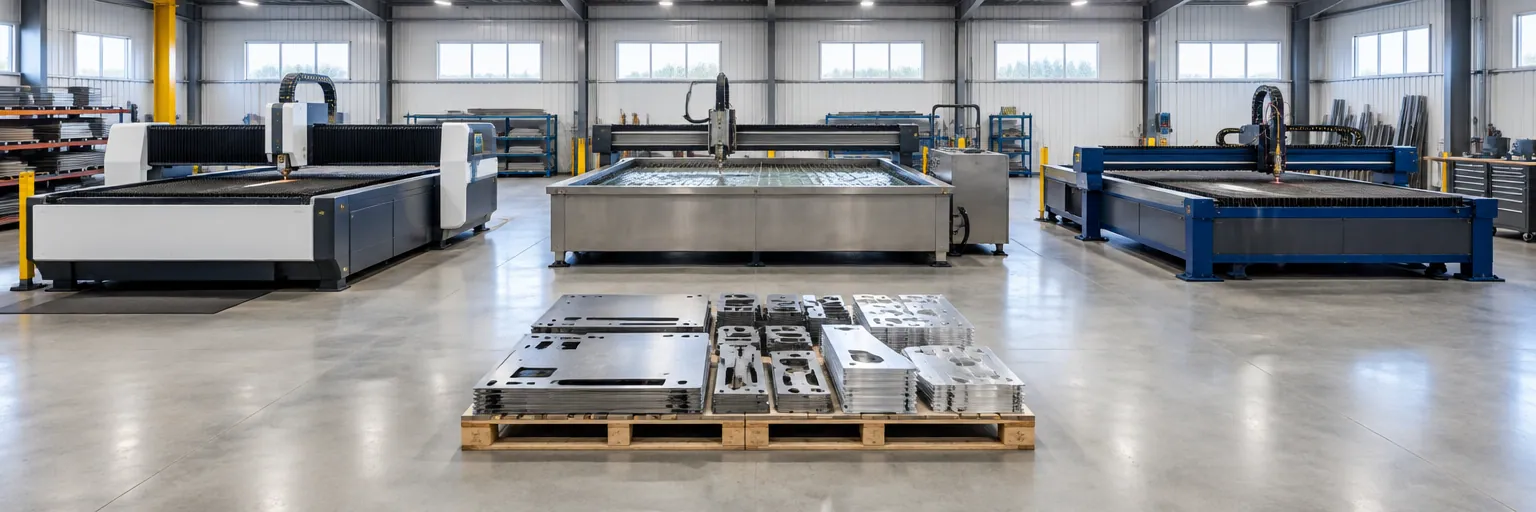
Laser, waterjet, and plasma cutting all cut flat patterns from sheet and plate on CNC machines without hard tooling. They differ sharply in how they cut, what materials they accept, how thick they go, and what they do to the edge. Choosing the right method comes down to your material, plate thickness, tolerance, and whether your part can tolerate heat.
How the three processes differ
Laser cutting melts or vaporizes material with a focused laser beam and uses an assist gas to blow the molten material out of the kerf. It is the most precise of the three methods, leaves the narrowest kerf, and can also engrave and part-mark by controlling beam depth. Because it is a thermal process, it leaves a small heat-affected zone.
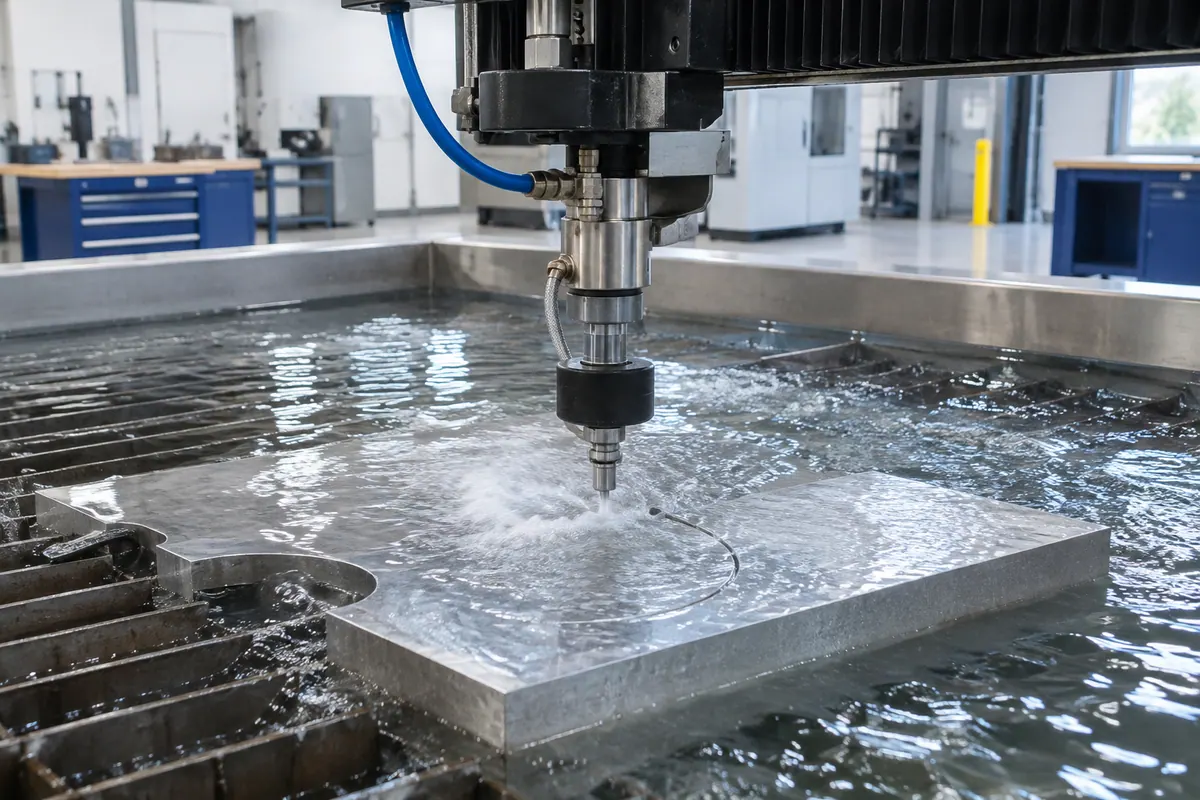
Waterjet cutting erodes material with a high-pressure jet of water that usually carries an abrasive. Because the water quenches the cut the entire time, there is no heat, no heat-affected zone, and no thermal distortion. It cuts almost any material, but it is much slower than laser cutting, less precise, and leaves a wider kerf.
Plasma cutting melts material with a constricted arc of ionized gas and blows the melt out of the kerf. The electrical arc must return through the workpiece to a grounding clamp, so the process works only on electrically conductive metals. It handles the thickest plate of the three at a much lower cost than laser cutting, but it leaves a rough, oxidized edge with heavy dross and a large heat-affected zone.
Materials and hazardous exceptions
Each cutting method has strict material boundaries based on conductivity, reflectivity, and how the stock reacts to heat:
- Low-carbon and austenitic stainless steels cut excellently on both laser and waterjet, and cut readily on plasma. On a laser, oxygen assist gas cuts carbon steel fastest and leaves an oxide edge, while nitrogen assist leaves a clean edge on carbon and stainless steel for welding or painting. Waterjet cuts stainless steel without altering corrosion resistance at the edge.
- Aluminum and titanium rate good on a laser. Aluminum is reflective and conducts heat well, so it requires enough laser power and is more likely to show dross and a rougher edge than steel. Titanium needs an inert assist gas on a laser so the edge does not oxidize and become brittle; waterjet avoids titanium heat issues altogether.
- Copper and brass rate fair on a laser because their high reflectivity and thermal conductivity require suited equipment and thin sections.
- Composites and laminates such as glass-fiber reinforced plastic (GFRP) rate excellent on waterjet because it cuts without heat or delamination. Waterjet also cuts stone, rubber, foam, and hardened or heat-treated metals.
- Acrylic cuts with a polished edge on a laser (rated excellent), and wood cuts and engraves with a charred edge (rated good). Thin glass is rated fair on a laser and also cuts on a waterjet. On clear plastics, waterjet leaves vertical striations that make the cut edge non-transparent.
- Polyethylene melts and drips under a laser (rated poor), and polycarbonate absorbs the beam poorly and discolors or chars (rated poor). Waterjet handles plastics that melt.
- Never laser cut PVC or PTFE. Both are unsuitable: PVC releases chlorine and hydrochloric acid that corrode the machine and harm people, and PTFE gives off toxic fumes when heated.
Thickness, precision, and kerf
Published figures from manufacturing services give a baseline for comparing thickness, tolerance, and kerf width, though every shop has its own limits. Always confirm capability with your supplier.
In Hubs' published comparison, laser cutting has a typical profile tolerance of ±0.05 mm (±0.002 in) and an average kerf width of about 0.3 mm, the finest of the three. Its recommended sheet thickness range is 0.5 mm to 10 mm (0.02 in to 0.394 in), becoming less efficient as thickness grows. Waterjet cutting holds a typical tolerance of ±0.2 mm (±0.008 in) with a kerf of 0.5 mm to 1 mm (0.02 in to 0.04 in), and suits an ideal thickness range of about 10 mm to 50 mm (10.16 mm to 50.8 mm, or 0.4 in to 2 in). Plasma cutting holds a typical tolerance of ±0.5 mm (±0.02 in) across an ideal range of 0.5 mm to 180 mm (0.02 in to 7.01 in).
Service defaults can differ from process capability tables. For example, Xometry's published service default for both laser and waterjet sheet cutting is ±0.010 in (±0.254 mm) measured edge to edge on the top face, and ±0.010 in on the inner face of laser-cut tube. For all three processes, cut tolerances apply to the profile only; part thickness tolerance comes from the raw stock. Flatness callouts are not guaranteed on ordinary sheet stock unless you specify ground stock or tooling plate.
Edge quality, heat, and standards
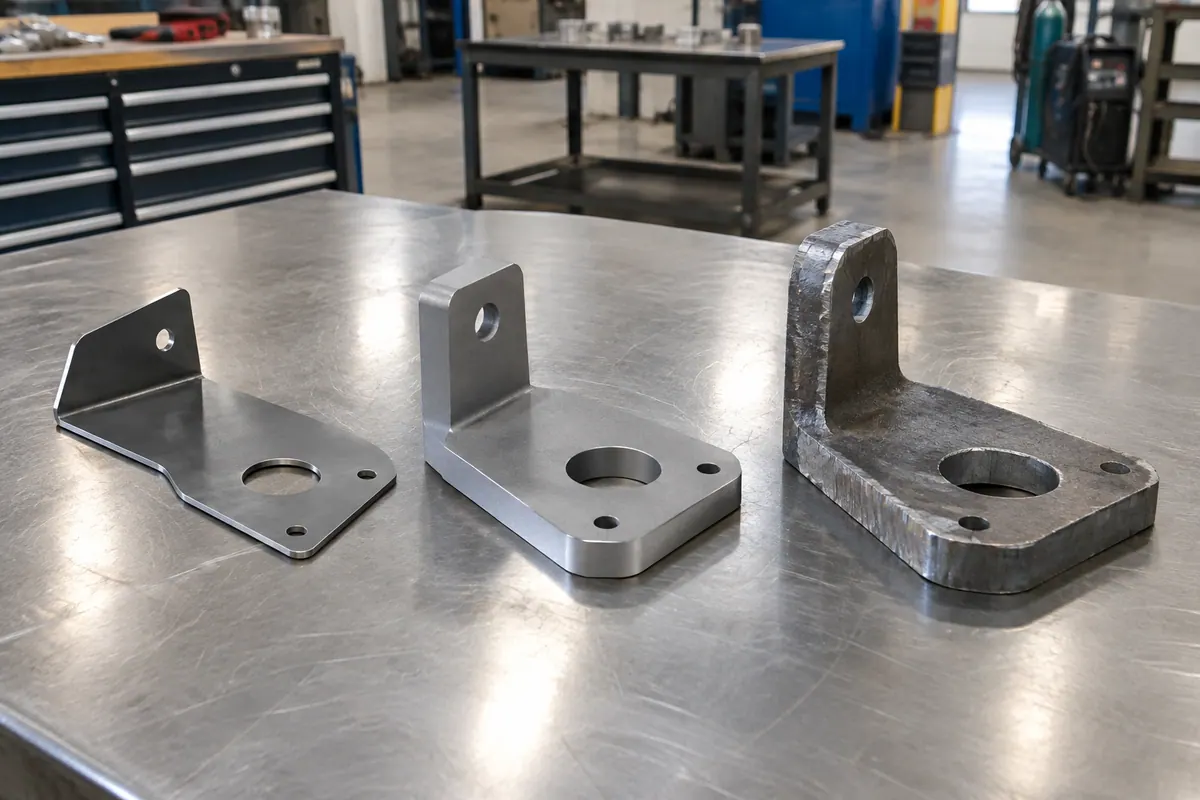
Laser and waterjet cuts both taper on thicker material, so dimensions on the bottom face can deviate from the top face. If a bottom-face dimension is critical, call it out on your drawing. Both processes also leave vertical striations on the cut face, a small bump or divot where the cut starts and ends (the lead-in and lead-out), and a possible halo of discoloration near the edge from laser overspray or waterjet backsplash.
Laser cutting leaves small to no burr, especially on thin stock, along with a narrow heat-affected zone. Waterjet leaves no burr or dross and zero heat-affected zone, though the high-pressure stream pushes hard enough to bend thin sheet near the cut if it is not well supported, and abrasive can embed in soft materials. On tight corners at high speed, waterjet machines must slow down to prevent jet lag.
Plasma edges are rough, non-perpendicular, and carry a large bottom burr of dross alongside an oxidized heat-affected zone. On stainless steel and aluminum, this heat-affected edge can interfere with subsequent welding or anodizing, and the heat can distort thin plate or long, narrow parts. Plasma pierces also leave a crater, so cuts should start in the waste stock.
Note that according to Xometry's published standards, laser and waterjet sheet parts are not deburred unless you select a deburring finish, and as-cut laser tubes have only large burrs and tabs removed. When edge perpendicularity and surface roughness matter on thermal cuts, call out a quality class from ISO 9013 on your drawing; that standard classifies laser cuts from 0.5 mm to 32 mm thick and plasma cuts from 0.5 mm to 150 mm thick.
When to choose each process
Use these rules of thumb to match your part to a process:
- Choose laser cutting for medium to thin sheet metal (0.5 mm to 10 mm) when you want tight tolerances, a narrow kerf, fast cutting, or part marking and engraving. It is the standard choice for the flat pattern of almost every bent sheet metal part, as well as acrylic and thin wood.
- Choose waterjet cutting when heat would ruin the material or edge, or when the plate is too thick for a laser (ideally 10 mm to 50 mm). Use it for hardened steel, titanium, GFRP and other composites, melting plastics, glass, stone, and intricate parts that must come off the table without burrs, dross, or thermal distortion. It is the slowest and most expensive of the three, so reserve it for parts that need its material range or cold cut.
- Choose plasma cutting for thick, electrically conductive plate (up to 180 mm) where cost matters more than edge finish or tight tolerance. It is built for structural plate, base plates, brackets, and weldment blanks. Leave extra stock for machining on mating faces, and plan to drill or machine holes that need to be round and straight.
Designing the flat pattern
For parts that will be formed on a press brake, always cut the flat pattern before bending. Cutting in the flat is faster and more precise, and accurate outer edges register better against the press-brake backgauges.
When designing for laser or waterjet, account for kerf, hole size, and sharp corners using published service guidelines (confirm exact rules with your shop):
- Split the kerf on mating parts: where two cut parts fit together, add half the kerf to the inner part and subtract half the kerf from the outer part (about 0.3 mm total kerf for laser; 0.5 mm to 1 mm for waterjet).
- Size and space laser-cut holes by thickness: Hubs recommends making hole diameters at least 1x the sheet thickness, placing them at least 1x thickness from an edge, 2x thickness apart from each other, and 2x thickness from the start of a bend radius. Plan a separate drilling or punching step for tiny holes.
- Watch small holes on laser and waterjet: in Xometry's guidelines, holes 0.100 in (2.54 mm) or smaller on sheet or tube may come out slightly larger on the top face because the pierce lands near the cut line.
- Round external corners: add fillets equal to half the sheet thickness on external corners so handled parts do not have sharp edges that cut people.
- Specify tube cut orientation: laser tube cuts are made normal to the tube surface by default; if you need normal-to-edge cuts, agree on that with the shop when ordering.
Design rules at a glance
| Rule | Value | Note | Source |
|---|---|---|---|
| Cutting mechanism | Laser: focused beam melts/vaporizes with assist gas; Waterjet: high-pressure water and abrasive erosion; Plasma: ionized gas arc melts conductive stock | Side-by-side comparison of how material is removed | [1] |
| Material compatibility | Laser: metals, acrylic, wood (never PVC or PTFE); Waterjet: almost any metal, composite, stone, glass, rubber, foam; Plasma: electrically conductive metals only | Confirm specific alloy and grade with your shop | [1] |
| Recommended or ideal thickness | Laser: 0.5 to 10 mm (0.02 to 0.394 in); Waterjet: 10.16 to 50.8 mm (0.4 to 2 in); Plasma: 0.5 to 180 mm (0.02 to 7.01 in) | Published guidance from Hubs; working range for laser and ideal range for waterjet and plasma | [2] |
| Typical profile tolerance (Hubs) | Laser: ±0.05 mm (±0.002 in); Waterjet: ±0.2 mm (±0.008 in); Plasma: ±0.5 mm (±0.02 in) | Published process comparison from Hubs; confirm capability with your shop | [2] |
| Service default top-face tolerance (Xometry) | Laser: ±0.010 in (±0.254 mm); Waterjet: ±0.010 in (±0.254 mm); Plasma: not listed | Xometry default edge-to-edge on top face of sheet (and inner face of laser tube), stock thickness excluded | [3] |
| Typical kerf width | Laser: ~0.3 mm average; Waterjet: 0.5 to 1 mm (0.02 to 0.04 in); Plasma: ask shop for kerf at plate thickness | Split the kerf (+1/2 inner, -1/2 outer) when cut parts assemble into each other | [2] |
| Heat-affected zone (HAZ) and distortion | Laser: small HAZ and possible minor distortion; Waterjet: none (quenched by water); Plasma: large HAZ, oxidized zone, and thermal distortion on thin/narrow part | Choose waterjet when heat would alter temper, corrosion resistance, or laminate bonds | [1] |
| Burr, dross, and edge finish | Laser: small to no burr, low roughness, slight taper; Waterjet: no burr or dross, vertical striations, slight taper; Plasma: rough edge, large bottom dross burr | Sheet parts on laser and waterjet are not deburred unless a finish is specified | [2] |
| Engraving and part marking | Laser: yes (with depth control); Waterjet: no (no depth control); Plasma: no | Use laser cutting when parts require etched markings or text | [2] |
| Relative cost and cutting speed | Laser: fast on thin sheet, moderate cost; Waterjet: slowest and most expensive of the three; Plasma: much cheaper than laser on thick conductive plate | From Hubs process comparison | [2] |
| Thermal cut quality standard (ISO 9013) | Laser: covers 0.5 to 32 mm thickness; Waterjet: not applicable (non-thermal); Plasma: covers 0.5 to 150 mm thickness | Call out ISO 9013 on drawings when perpendicularity and roughness must be controlled | [1] |
| Minimum hole diameter and spacing (laser) | Diameter ≥ 1x thickness; edge distance ≥ 1x thickness; hole-to-hole ≥ 2x thickness; distance to bend ≥ 2x thickness | Hubs guideline for laser-cut sheet metal; holes ≤ 0.100 in (2.54 mm) may run large on top face | [2] |
Common questions
- Why can't I laser cut PVC or PTFE?
- Both materials release hazardous gases when heated by the laser beam. PVC releases chlorine and hydrochloric acid, which corrode the laser machine and harm operators. PTFE releases toxic fumes. Use waterjet cutting instead for plastics that burn, melt, or fume.
- When is waterjet cutting worth the higher cost over laser cutting?
- Choose waterjet when heat would damage the part or when the material cannot be cut cleanly by a laser. That includes plate thicker than 10 mm, heat-treated or hardened metals, titanium, GFRP composites (which delaminate with heat), plastics that melt like polyethylene, stone, and glass.
- How do I account for kerf when two cut parts fit together?
- Add half the kerf width to the inner part and subtract half the kerf width from the outer part. In Hubs' published guidance, laser kerf averages about 0.3 mm and waterjet kerf ranges from 0.5 mm to 1 mm (0.02 in to 0.04 in). Because exact kerf depends on the material, thickness, and machine, confirm the value with your shop for tight fits.
- Why are my holes slightly oversized or tapered on thick plate?
- Both laser and waterjet cuts naturally taper from top to bottom on thicker stock, so the bottom face can deviate from the top-face tolerance. In addition, on holes 0.100 in (2.54 mm) or smaller, the cutter pierces very close to the hole's cut line, which can make the hole slightly larger on the top face. For tight, straight holes in thick plate, especially with plasma cutting, plan a secondary drilling or machining operation.
- How do I specify edge quality on a drawing for laser or plasma cuts?
- Call out a quality class from ISO 9013 on your drawing. ISO 9013 classifies the perpendicularity and surface roughness of thermal cuts, covering laser cuts from 0.5 mm to 32 mm thick and plasma cuts from 0.5 mm to 150 mm thick. Also specify a deburring finish if you need burrs removed, as standard as-cut sheet parts are delivered without deburring.