Steel heat treatment design guide: quench, case harden, nitride
Learn how annealing, quenching and tempering, case hardening, and nitriding change steel properties, plus how to design parts and call out treatments.
Heat treatment uses controlled heating and cooling to change the microstructure and mechanical properties of a steel part without changing its shape. Choosing the right process lets you soften stock for machining, harden a part all the way through, or put a wear-resistant skin over a tough core. Because hardenability belongs to the alloy rather than the furnace, you must match the steel grade, section size, and heat treatment from the start.
What heat treatment does and when to use each process
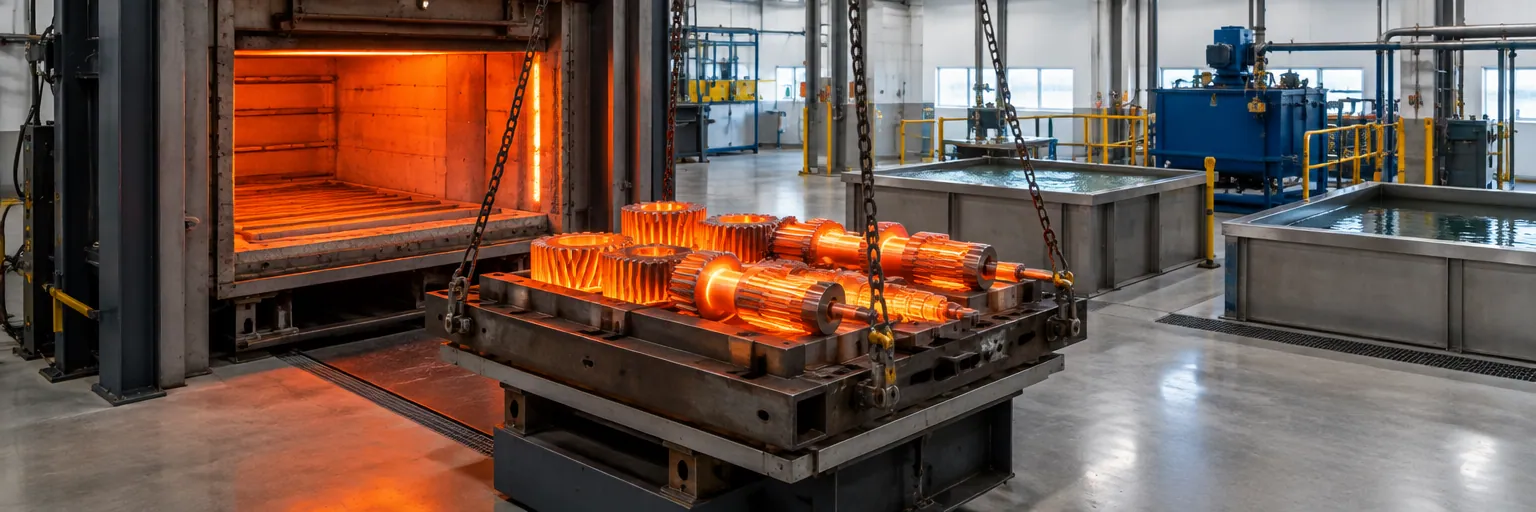
Heat treatment changes steel properties in a furnace with controlled atmospheres, quench tanks, and tempering ovens. Different treatments solve different design problems:
- Annealing heats the metal and cools it slowly to soften it, relieve internal stresses, and restore ductility. The metal recrystallizes and replaces work-hardened grains with soft ones. Use it when cold-worked stock must be formed further, when a hardened steel must be machined before re-hardening, or when a casting or weldment needs softening. Its close relatives are stress relieving, which uses less heat to remove only stress while keeping hardness, and normalizing, which air-cools from above the transformation range to refine grain.
- Quenching and tempering heats steel above its transformation range to dissolve carbon, cools it rapidly in water, oil, polymer, or air to trap carbon in a hard, brittle martensitic structure, and reheats it to a lower temperature. Tempering trades some hardness for toughness. Use it for shafts, gears, bolts, springs, tooling, and structural pins that need strength and hardness throughout their cross-section.
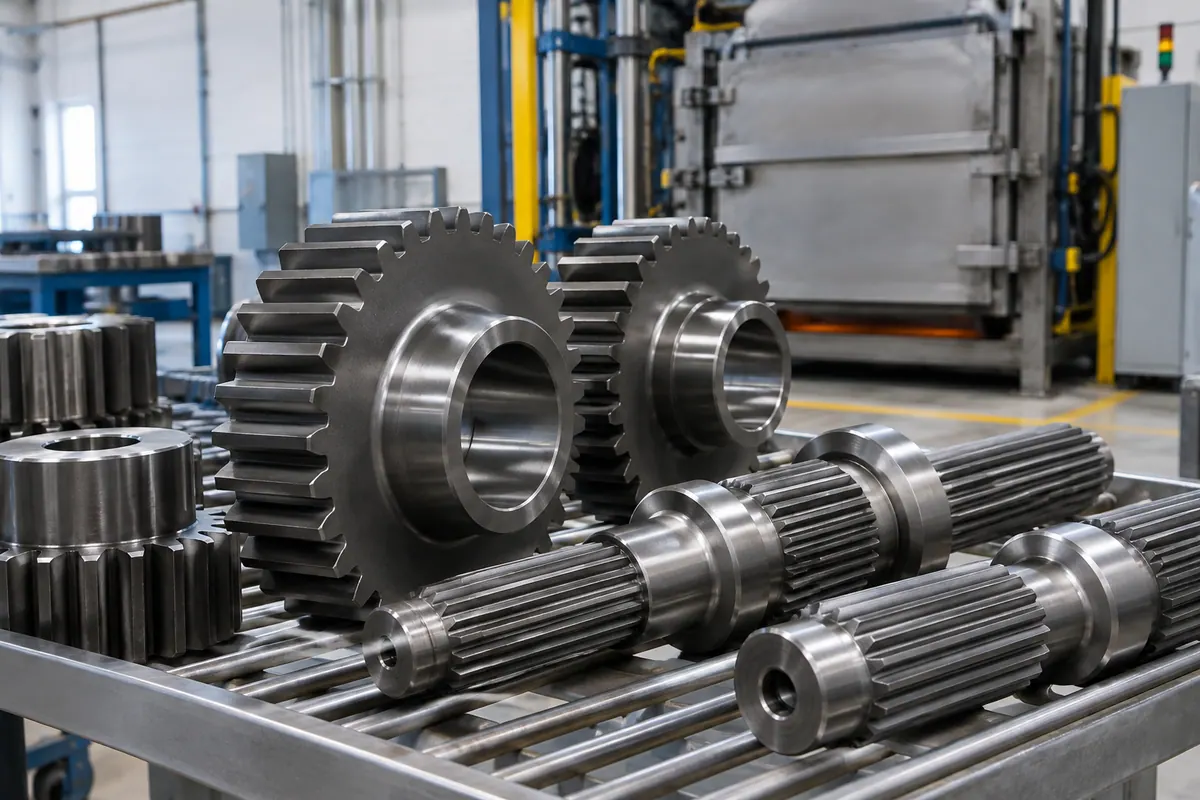
- Case hardening hardens only the surface layer, leaving a tough core to handle shock and bending while the compressed surface resists wear, contact stress, and fatigue. Carburizing diffuses carbon into a low-carbon steel surface at high temperature before quenching. Carbonitriding diffuses both carbon and nitrogen. Induction and flame hardening heat and quench only the skin of a medium-carbon or alloy steel. Use case hardening for gears, cams, sprockets, rollers, and shafts, including round shafts that serve as rails for linear ball bushings where point loads would deform a soft surface.
- Nitriding is a variant of case hardening that diffuses nitrogen into the surface from ammonia gas, a salt bath, or plasma at a temperature below the steel's transformation range. It needs no quench and relies on alloying elements to form hard nitrides. Use it on already quenched and tempered parts like precision gears, spindles, cylinder liners, valves, extrusion screws, dies, and molds that need a very hard, thin, wear- and scuff-resistant case with minimal distortion.
Other property-changing treatments exist for specific cases. Solution treatment and aging strengthens precipitation-hardening alloys. When you need better surface fatigue life without any heat, shot peening is a mechanical alternative, while vapor deposition or plating can apply a hard coating if a part cannot go into a furnace.
Matching the steel grade to the treatment
Hardenability is a property of the steel alloy, not the furnace. Ordering a through-hardened part in a material that cannot harden asks a shop for something that cannot be made.
- Low-carbon steel has too little carbon to harden by quenching. If a low-carbon steel part needs a hard wear surface, specify carburizing or carbonitriding.
- Austenitic stainless steel cannot be hardened by heat treatment at all. You can only anneal it to soften it and relieve stress.
- Medium-carbon and high-carbon steels respond very well to quenching and tempering, with high-carbon grades reaching the highest hardness among carbon steels. However, plain carbon steels have shallow hardenability; in heavy sections, the center cools slower than the outside, so only the surface layer hardens.
- Alloy steels, including chromium-molybdenum and nickel-chromium-molybdenum steels, harden much deeper. Nickel-chromium-molybdenum grades can harden deep even in large sections.
- Martensitic stainless steel is the only common stainless family hardened by quenching and tempering. Cold-work and hot-work tool steels also respond very well to quenching and tempering.
- Nitriding steels must contain nitride-forming alloying elements such as aluminum, chromium, or molybdenum. Before nitriding, the part must already be quenched and tempered at a tempering temperature higher than the nitriding temperature so the core keeps its strength.
Designing parts to survive the furnace and quench
Rapid cooling sets up thermal gradients, and the hard phase expands as it forms. Uneven cooling and volume changes warp parts and start quench cracks. Good geometry reduces these risks:
- Keep cross-sections uniform. Thick and thin sections heat and cool at different rates, causing the part to twist or warp between them.
- Avoid sharp internal corners, stamped marks, and abrupt steps in section thickness. Use generous radii everywhere, because quench cracks start at stress concentrations.
- Place holes, slots, and keyways away from edges so they do not leave a thin wall that cools much faster than the metal next to it.
- Match case depth to wall thickness. A carburized case that is too deep for a thin section or sharp edge will harden the feature all the way through, leaving it brittle enough to snap. A case that is too shallow for a heavy contact load will crush and spall into the softer core.
- Radius edges on nitrided parts. Nitriding forms a hard, brittle white compound layer at the surface that can chip at sharp corners or flake under impact; specify its removal on surfaces loaded in bending.
- Ensure tool access for local hardening. Induction and flame hardening require a clear path for the heating coil or flame to reach the surface evenly, and holes or keyways inside the heated zone act as crack sites.
Machining sequence, distortion, and surface protection
Heat-treated parts move and change size. Your manufacturing sequence and stock allowances must account for distortion and surface changes.
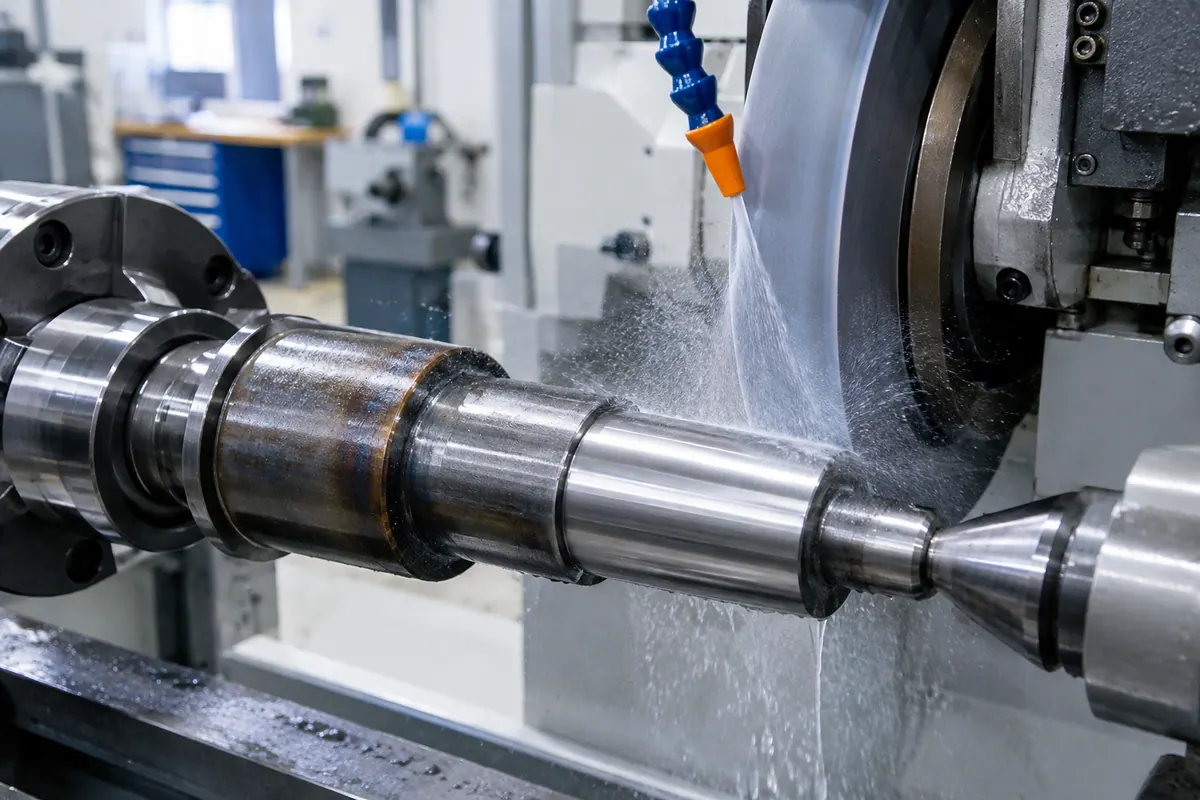
For quenched and tempered or carburized parts, rough machine the part, heat treat it, and then finish machine or grind critical bores, faces, and threads to final tolerance. Leave extra stock before treatment to clean up distortion. If the furnace does not use a protective atmosphere, oxygen and heat will form scale and decarburize the surface, leaving a soft skin right where you need hardness; your grinding allowance must be deep enough to remove this layer.
Remember that finish grinding removes part of a hardened case. Always specify the effective case depth that must remain after final grinding.
Nitriding is the exception to the rough-then-finish sequence. Because there is no quench and temperatures stay low, distortion is very small. You finish machine the quenched and tempered part first, nitride it, and follow with at most a light lap or polish. Grinding away a thin nitrided case would destroy it. Keep in mind that nitriding causes slight, predictable growth on finished dimensions, and parts must be completely free of oil, oxide, or old coatings so nitrogen diffuses evenly.
Protect features that must stay soft. Threads, holes to be tapped later, and areas to be welded after treatment will become hard and brittle if exposed to carburizing or nitriding; have the shop mask or copper-plate those surfaces. Finally, watch post-treatment operations: heavy grinding can cause grinding burn, and welding will locally re-temper and soften a hardened part.
How to call out heat treatment on a drawing
Specify the end condition and properties the part must have, not the furnace recipe. Leave soak times, temperatures, atmospheres, and quench media to the heat treater, who selects them based on your alloy and section size.
SAE AMS 2759 governs the heat treatment of steel parts, covering furnace and equipment classes, temperature uniformity, atmospheres, quenchants, tempering, stress relief, hardness testing, and records. Its slash sheets define the specific process parameters for each steel family.
A complete drawing callout should state:
- The governing standard, such as AMS 2759 and the applicable slash sheet for the steel family.
- The required condition (for example, anneal, quench and temper, carburize and harden, or nitride).
- The required hardness range or strength condition, and the exact location on the part where hardness is to be measured.
- For case-hardened and nitrided parts, the effective case depth, surface hardness, and core hardness, clearly stating that case depth applies after final grinding.
- Any surfaces to be masked from case hardening or nitriding, whether the brittle white compound layer from nitriding must be removed, and whether dimensions apply before or after treatment.
Never write a vague note like "harden" on a drawing; the shop will not know whether you want through-hardening or case hardening, or what hardness to hit.
Design rules at a glance
| Rule | Value | Note | Source |
|---|---|---|---|
| Governing standard for steel heat treatment | SAE AMS 2759 | Covers furnace classes, atmospheres, quenchants, tempering, testing, and slash sheets per steel family; confirm specific parameters with your heat treater. | [1] |
| Low-carbon steel (general heat treatment / quench) | Rated poor | Too little carbon to harden by quenching; specify case hardening (carburizing or carbonitriding) for a hard surface. | [1] |
| Austenitic stainless steel (hardening) | Rated poor | Cannot be hardened by heat treatment; only anneal to soften and restore ductility. | [1] |
| Medium-carbon steel (quenching and tempering) | Rated excellent | Hardens and tempers to the required strength; plain carbon grades harden only near the surface in heavy sections. | [1] |
| High-carbon steel (quenching and tempering) | Rated excellent | Reaches the highest hardness of the carbon steels; shallow hardening in thick sections. | [1] |
| Chromium-molybdenum steel (quenching and tempering) | Rated excellent | Hardens through moderate sections, with final strength set by the tempering temperature. | [1] |
| Nickel-chromium-molybdenum steel (quenching and tempering) | Rated excellent | Deep hardening even in large cross-sections. | [1] |
| Martensitic stainless steel (quenching and tempering) | Rated excellent | The only common stainless steel family hardened by quenching and tempering. | [1] |
| Cold-work and hot-work tool steels (quenching and tempering) | Rated excellent | Standard hardening route for tool steel families. | [1] |
Common questions
- Why can't I through-harden low-carbon steel or austenitic stainless steel?
- Low-carbon steel lacks enough carbon to form a hard structure when quenched; to give it a hard wear surface, you must diffuse carbon into the skin by carburizing or carbonitriding. Austenitic stainless steel does not undergo the phase transformation needed to harden by heat treatment at all, so it can only be annealed to soften it.
- When should I choose nitriding over carburizing?
- Choose nitriding when you need a very hard, thin, wear-resistant surface on a finish-machined alloy steel part with minimal distortion. Nitriding runs below the transformation temperature and needs no quench, so you do not have to grind away warpage afterward. Choose carburizing when using low-carbon steel or when high contact loads require a deeper case, and plan to finish grind the part after quenching.
- Should I specify furnace temperatures and soak times on my drawing?
- No. Specify the required outcome: the treatment type, target surface hardness, core hardness, effective case depth after grinding, measurement locations, and the governing standard (such as AMS 2759). Let the heat treater select the temperatures, times, and quench media based on the steel grade and part thickness.
- How do I prevent parts from cracking or warping during quenching?
- Design parts with uniform wall thicknesses so sections cool at the same rate. Replace sharp internal corners and abrupt thickness steps with generous radii, keep holes and keyways away from thin edges, and avoided stamped marks in high-stress areas. Leave machining stock on critical features so distortion can be ground away after tempering.
- What happens if I anneal a cold-worked part?
- Annealing causes recovery, recrystallization, and grain growth, which permanently removes the strength and hardness gained from cold working. Only anneal a cold-worked part if you need to restore ductility for further forming or machining and the lower strength is acceptable.