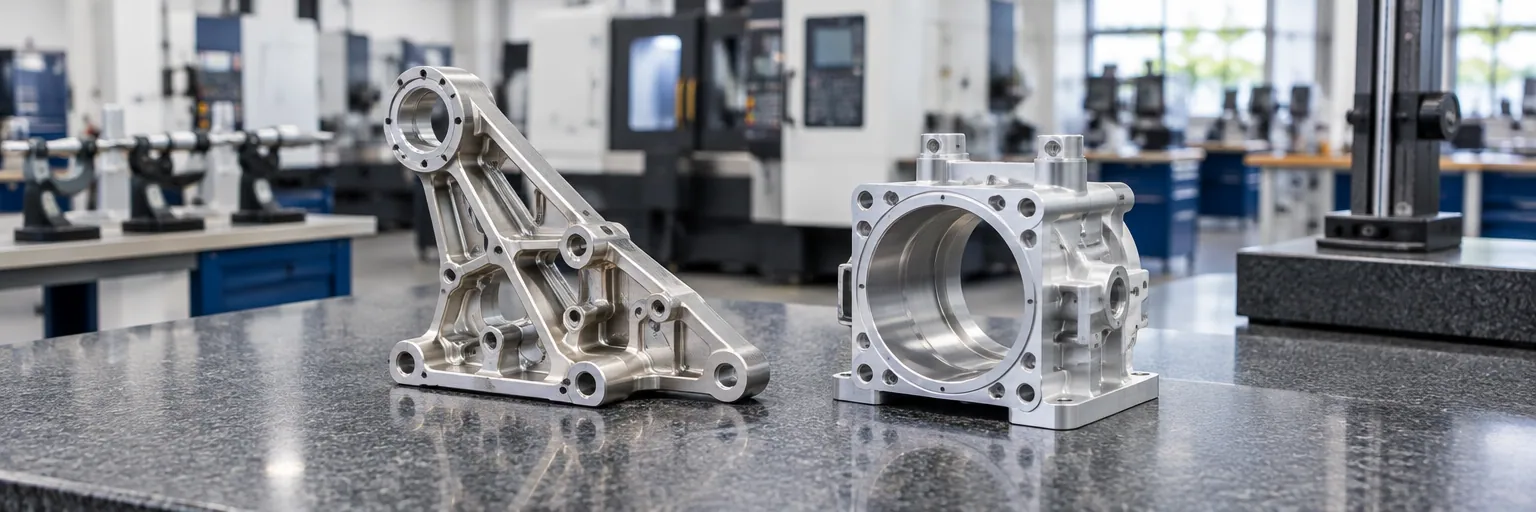
6061-T6 vs 7075-T6 aluminum: strength, machining and which to choose
Compare 6061-T6 and 7075-T6 aluminum across strength, stiffness, machinability, weldability and corrosion resistance to pick the right alloy for machined parts.
6061-T6 and 7075-T6 are the two workhorse wrought aluminum alloys in machine shops. Both are solution heat treated and artificially aged to the T6 temper, and both weigh roughly a third as much as steel. The choice between them comes down to a simple trade: 6061-T6 is the general-purpose default that welds and resists corrosion, while 7075-T6 delivers nearly double the yield strength for highly stressed parts that will not be welded.
How 6061-T6 and 7075-T6 differ
6061-T6 is a magnesium-silicon (Al-Mg-Si) alloy and the standard general-purpose structural aluminum. When a drawing calls out aluminum without a grade, 6061-T6 is the alloy to assume. Most shops keep it in stock as plate, bar and extrusion. It offers a typical yield strength of 276 MPa, ultimate tensile strength of 310 MPa, shear strength of 207 MPa and hardness of 95 HB at a density of 2.70 g/cm³.
7075-T6 is a zinc-magnesium-copper (Al-Zn-Mg-Cu) aerospace alloy built for high strength. At 2.81 g/cm³, it weighs almost the same as 6061-T6 but reaches a typical yield strength of 503 MPa, ultimate tensile strength of 572 MPa, shear strength of 331 MPa and hardness of 150 HB.
What 7075-T6 does not buy you is stiffness. Its typical modulus of elasticity is 71.7 GPa against 68.9 GPa for 6061-T6. Because both sit near 70 GPa (roughly a third of steel), an aluminum part of either grade deflects about three times as much as a steel part of the same geometry. If your part is deflection-limited rather than stress-limited, switching from 6061-T6 to 7075-T6 will not fix it; you need more section or a stiffer material family.
Machinability, thermal properties and shop behavior
Both alloys machine at high speeds with light cutting forces and long tool life, but chips break differently. On the 0 to 100 aluminum machinability scale, 7075-T6 rates 70 percent while 6061-T6 rates 50 percent. 7075-T6 is harder (150 HB vs 95 HB), which gives cleaner chips and a crisp surface finish on precision machined parts. 6061-T6 machines cleanly too, but it is gummier, so sharp tools and good chip evacuation matter more.
Thermal behavior also separates the two alloys in service and on the machine:
- Thermal conductivity: 6061-T6 conducts heat at 167 W/(m·K) compared to 130 W/(m·K) for 7075-T6, making 6061-T6 the better pick for heat sinks and thermal paths.
- Melting range: 7075-T6 has a lower solidus temperature of 477 °C (liquidus 635 °C) compared to 582 °C (liquidus 652 °C) for 6061-T6. Because 7075-T6 begins to melt at 477 °C and loses temper strength well below that, avoid hot processes and take care with aggressive dry machining.
- Thermal expansion: Both alloys have a typical coefficient of thermal expansion of 23.6 µm/(m·K) from 20 to 100 °C. That is roughly twice steel's 11 µm/(m·°C), so account for thermal growth when designing press fits against steel or inspecting tight tolerances at varying temperatures.
Weldability, corrosion and finishing
If your part requires fusion welding, choose 6061-T6. Inert-gas welding of 6xxx-series aluminum is routine, whereas 7075-T6 is prone to cracking when melted and should not be arc welded. Keep in mind that welding any T6 alloy softens the metal in the heat-affected zone by annealing or overaging the precipitate structure. You must either design a welded 6061-T6 assembly to the lower annealed strength near the joint or re-heat-treat the weldment afterward, which can cause distortion. Where 7000-series alloys must be joined without fasteners, friction stir welding is an option because it joins the metal in the solid state without melting.
Corrosion resistance follows the same split. 6061-T6 resists corrosion well without cladding or coatings. 7075-T6 has lower corrosion resistance and is susceptible to stress-corrosion cracking, especially in the short-transverse direction of thick plate. If a 7075-T6 part will see moisture or salt, plan to anodize it, coat it, or specify an over-aged temper.
Both alloys take anodizing well, growing a hard, dyeable oxide layer. When designing anodized assemblies with mechanical hardware, follow shop rules to avoid galvanic and bath problems:
- Do not install steel or stainless steel self-clinching fasteners before anodizing; install them after the anodizing bath.
- Use stainless steel or aluminum hardware rather than carbon steel in aluminum parts to prevent rapid galvanic corrosion.
- For tapped holes directly in aluminum, provide a thread engagement of 1.5 to 2.5 times the fastener diameter, or install coiled wire inserts (Heli-coils) or key inserts so the bolt fails before the aluminum threads strip.
When to choose 6061-T6
Make 6061-T6 your default choice until a specific load calculation forces you into a stronger alloy. Because it is the most widely stocked aluminum in plate, bar and extruded profiles, it is the alloy to specify when a part simply needs to be made quickly and cheaply.
Choose 6061-T6 for:
- Brackets, fixtures, housings, frames, fittings and machined plates with moderate loads.
- Assemblies joined by fusion welding.
- Parts exposed to moisture or outdoor environments where bare corrosion resistance matters.
- Heat sinks and thermal management plates that benefit from its 167 W/(m·K) thermal conductivity.
If your design involves sheet metal bending rather than machining from solid, note that T6 tempers in both alloys bend poorly and can crack on tight radii. 6061-T6 sheet needs an inside bend radius larger than the 0.030 in (0.76 mm) common in softer metals, and 5xxx-series alloys such as 5052-H32 are preferred for bent sheet metal parts.
When to choose 7075-T6
Step up to 7075-T6 when strength per kilogram governs the design and the part will be machined from solid billet or plate rather than welded. Its 503 MPa typical yield strength lets you carry nearly twice the load of 6061-T6 in the same cross-section, or slim down wall thicknesses to save weight.
Choose 7075-T6 for:
- Aircraft fittings and highly loaded structural brackets.
- Machined gears, shafts and high-stress mechanical components.
- Tooling and precision fixtures that must resist yielding under clamp or press loads.
When detailing a 7075-T6 part, avoid sharp internal corners and notches in loaded regions. Its typical elongation at break is 11 percent (compared to 12 percent for 6061-T6), giving it slightly less ductility and forgiveness at stress concentrations.
Specifying the material on your drawing
Never write just aluminum on a print for a structural part. Specify the alloy, the temper and the governing material standard.
For 6061-T6, common standards include ASTM B209 for sheet and plate, ASTM B211 for rolled or cold-finished bar, rod and wire, ASTM B221 for extruded bars, rods, profiles and tubes, and SAE AMS 4027 for aerospace sheet and plate. For 7075-T6 sheet and plate, call out SAE AMS 4045.
Remember that the 276 MPa and 503 MPa yield strengths listed in alloy overviews are typical room-temperature datasheet values, not guaranteed minimums. Minimum tensile and yield strengths depend on product form and section thickness as defined in the ASTM or AMS specification. If your safety factor depends on a guaranteed minimum, design to the standard's allowables for your stock thickness and require a mill test certificate from your supplier.
Design rules at a glance
| Rule | Value | Note | Source |
|---|---|---|---|
| Alloy composition family | 6061-T6: Al-Mg-Si; 7075-T6: Al-Zn-Mg-Cu | Both are wrought alloys, solution heat treated and artificially aged. | [1] |
| Typical yield strength | 6061-T6: 276 MPa; 7075-T6: 503 MPa | Room-temperature typical values, not minimum design allowables. | [1] |
| Typical ultimate tensile strength | 6061-T6: 310 MPa; 7075-T6: 572 MPa | Room-temperature typical values. | [1] |
| Typical shear strength | 6061-T6: 207 MPa; 7075-T6: 331 MPa | Room-temperature typical values. | [1] |
| Typical modulus of elasticity | 6061-T6: 68.9 GPa; 7075-T6: 71.7 GPa | Average of tension and compression; compression modulus is about 2 percent greater. | [1] |
| Typical elongation at break | 6061-T6: 12 percent; 7075-T6: 11 percent | Measured on 1.6 mm (1/16 in) thickness at room temperature. | [1] |
| Typical Brinell hardness | 6061-T6: 95 HB; 7075-T6: 150 HB | 500 kg load with a 10 mm ball. | [1] |
| Typical density | 6061-T6: 2.70 g/cm³; 7075-T6: 2.81 g/cm³ | Both weigh roughly one-third as much as steel. | [1] |
| Machinability rating (0 to 100 aluminum scale) | 6061-T6: 50 percent; 7075-T6: 70 percent | 6061-T6 is gummier; 7075-T6 breaks cleaner chips. | [1] |
| Typical thermal conductivity | 6061-T6: 167 W/(m·K); 7075-T6: 130 W/(m·K) | 6061-T6 is preferred for heat sinks and thermal paths. | [1] |
| Typical coefficient of thermal expansion (20 to 100 °C) | 6061-T6: 23.6 µm/(m·K); 7075-T6: 23.6 µm/(m·K) | Roughly twice the thermal expansion of steel. | [1] |
| Typical solidus and liquidus temperatures | 6061-T6: 582 to 652 °C; 7075-T6: 477 to 635 °C | 7075-T6 starts melting at a lower temperature; avoid hot processes. | [1] |
| Common material specifications | 6061-T6: ASTM B209, B211, AMS 4027; 7075-T6: AMS 4045 | Standards define guaranteed minimum properties by product form and thickness. | [1] |
Common questions
- Is 7075-T6 stiffer than 6061-T6?
- No. 7075-T6 has a typical elastic modulus of 71.7 GPa compared to 68.9 GPa for 6061-T6. That difference is negligible in practice. Switching to 7075-T6 prevents yielding under higher loads, but it will not noticeably reduce part deflection.
- Which alloy machines better, 6061-T6 or 7075-T6?
- Both machine very well, but 7075-T6 rates 70 percent on the aluminum machinability scale compared to 50 percent for 6061-T6. Because 7075-T6 is harder (150 HB vs 95 HB), it forms smaller, cleaner chips and leaves a crisp finish, whereas 6061-T6 is gummier and requires more attention to tool sharpness and chip evacuation.
- Can you weld 7075-T6 aluminum?
- Do not plan on fusion welding 7075-T6. It is prone to solidification cracking when melted and loses its T6 strength in the heat-affected zone. If a part must be arc welded, use 6061-T6 and account for the softer heat-affected zone, or use friction stir welding if a 7000-series joint is required.
- Does 7075-T6 corrode faster than 6061-T6?
- Yes. 6061-T6 has good bare corrosion resistance, while 7075-T6 resists corrosion less well and is vulnerable to stress-corrosion cracking in the short-transverse direction of thick plate. 7075-T6 parts used in moist or salt environments are typically anodized, coated, or specified in an over-aged temper.
- How deep should tapped threads be in 6061-T6 and 7075-T6?
- For tapped holes in softer metals like aluminum, design for a thread engagement depth of 1.5 to 2.5 times the fastener diameter to prevent stripping, or specify coiled wire inserts (Heli-coils) or key inserts so the fastener fails before the threads.